 |
| Penny Singleton and Humphrey Bogart. |

Showing posts with label Musical. Show all posts
Showing posts with label Musical. Show all posts
Thursday, June 16, 2011
Swing Your Lady (1938)

Wednesday, June 8, 2011
Second Chorus (1940)
 |
| Fred Astaire, Paulette Goddard, and Burgess Meredith. |
Second Chorus is no life changing discovery, but while it belies the substantial talent of its principals, there's definitely enough punch left in the performances to make it an entertaining hour and a half. The script is far too weak to support the weight of its cast. There's not much of a plot, far too little music and almost no dancing, and hardly any acting required from anyone involved. This may actually be something of an advantage for Fred Astaire and Artie Shaw, but the lovely Paulette Goddard and a shockingly young Burgess Meredith could have easily filled out more substantial roles, and character actor Charles Butterworth could, I am convinced, play anything you put in front of him.
Big Band films proliferated in the early 40's, and Artie Shaw was well set up to have a starring vehicle after his spectacular successes of the late 30's. This is not that film. Artie Shaw and his orchestra function in Second Chorus much like Baby the Leopard in Bringing Up Baby. The plot revolves around him, but you could also tweak the script a little so he never had to appear on camera and it wouldn't really change it much. The music sequences, such as they are, are neither well-filmed nor well-integrated, so they simultaneously do not seem to belong in the film and are not interesting enough in themselves to justify their inclusion on their own merits. The sounds Shaw milks out of a clarinet are stunning as usual, but need more visual punch in the stagings to hold them up on screen, and in this case it just isn't there.
Astaire himself cited Second Chorus as his personal least favorite of his films, and while I haven't seen all of them yet, I imagine he wasn't far off. He plays a small-time college band leader, which sounds promising enough to start with. Personally I am really only prepared to accept Astaire in about four different types of roles: dancer, band leader, producer/promoter, or millionaire playboy. Anything too far beyond this falls a bit flat, like his abysmally unprofessional psychiatrist in Carefree. Of course, no one watches Fred Astaire to see him act, but unfortunately that's about all he does in Second Chorus. He has a paltry two dance numbers, in one of which we are expected to believe that he is simultaneously tap dancing, conducting an orchestra, and playing the trumpet, but even setting aside the plot holes it's a weak performance compared to almost any Astaire solo dance. "I've Got My Eye on You" from Broadway Melody of 1940, which was made the same year, shames this number to hell in a hand basket.
 |
| Fred and Paulette, having fun. |
 |
| The absolutely delightful Charles Butterworth. |
Sometimes you really do find buried gold, but more often what you see is just a flicker of light and shadow, beautiful for a moment, but insubstantial. Second Chorus is by any objective criteria a terrible film, but that doesn't mean it's not worth watching.
Thursday, May 19, 2011
Silk Stockings (1957)

As a follow up to the pairing of Fred Astaire and Cyd Charisse in The Bandwagon (1953), Silk Stockings is a monumental disappointment. The musicals of the early 50's had reached a pinnacle of innovation and slick professionalism that was never to be seen again. What followed was not so much a decline as a wall forever imprisoning the magical world of fantasy and dance in the past, in a time where television had not yet bled the cinema of much of its mystique. True, there were moments of greatness to follow--Gigi (1958), Oklahoma! (1955), and The Sound of Music (1965)--but there was also the tragically flawed Brigadoon (1954), which even the exquisite ballet of Gene Kelly and Cyd Charisse can't save from its own mediocrity. Like Brigadoon, Silk Stockings promises its audience an escape from the humdrum into a world of exotic romance, and utterly fails to deliver the goods.
Wednesday, May 11, 2011
Call Me Madam (1953)
 |
| Ethel Merman and Donald O'Connor |
When 20th Century Fox lost the music rights for Irving Berlin's score to Call Me Madam, the film was withdrawn from public exhibition for twenty years. Consequently, it is not as well known as other big production musicals of the day, such as The Band Wagon, Kiss Me, Kate and Brigadoon, though it can comfortably stand alongside these better-remembered films. Thankfully, it resurfaced on DVD in 2004, and can now reclaim its place among the finest musicals of the 1950's.
Thursday, April 28, 2011
The Rabbit of Seville (1950)
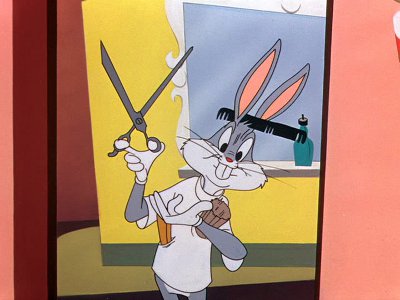 |
| Bugs Bunny as The Rabbit of Seville |
Tuesday, April 26, 2011
Thrill of a Romance (1945)
 |
| Esther Williams, "America's Mermaid" |
Thursday, April 21, 2011
Honolulu (1939)
 |
| Eleanor Powell and Robert Young |
Believe me, the last thing I want to do is say a harsh word about any of the paltry handful of films left to us by the great Eleanor Powell. When she retired in her prime in 1944 to get married, a terrible blow was dealt to the world of movie musicals, and I'm not sure MGM ever really recovered (although signing Ann Miller in 1948 was a solid step in the right direction). She matched an endearing girl next door charm with just a touch of Hollywood glamor and the fastest damned footwork you've ever seen. She starred in only nine films, plus a couple of supporting roles, far too few for a woman of her tremendous talent. While several of these films, such as Born to Dance and all three Broadway Melody titles, rank among the finest musicals ever made, others just don't make the cut.
Wednesday, March 30, 2011
Broadway Melody of 1940 (1940)

Wednesday, March 16, 2011
For Me and My Gal (1942)
 |
| Judy Garland as Jo Hayden |
Magic. It doesn’t matter how many times I watch For Me and My Gal; from the first chord of the title song I’m hooked. Gene Kelly is a two-bit comic vaudeville dancer, who has decided that a double act with Judy Garland is his ticket to fame and fortune. The fact that she is already part of a team doesn’t bother him much. “You had me pegged,” he tells her, “I’m never gonna win any blue ribbons for being a nice guy.” He’s right, too. Kelly’s character proves time and again in this film that he is pretty much a worthless cad. Fortunately, Kelly himself is likable enough to pull it off, so we root for him anyway.
Subscribe to:
Posts (Atom)